

Our Digital Compassion Work
As digital technologies become increasingly embedded in healthcare, new opportunities and challenges emerge for maintaining compassion, trust, and human connection. Through an ongoing partnership with AMS Healthcare, this work has advanced digital compassion through research, education, patient engagement, organizational guidance, and equity-focused initiatives. Together, these efforts have produced practical tools and resources that support compassionate care in digital healthcare environments.
Genesis of Digital Compassion
Digital compassion emerged from a growing recognition that healthcare was rapidly evolving from face to-face and paper-based interactions to increasingly digital environments shaped by technologies such as electronic health records, virtual care, patient portals, and artificial intelligence. As these technologies became more integrated into care delivery, questions began to emerge about how healthcare systems could preserve human connection, therapeutic relationships, and compassionate care within digital environments.

The concept was first explored in the book Without Compassion, There Is No Healthcare: Compassionate Care in Technological World. In the chapter Caring in a Digital Age: Exploring the Interface of Humans and Machines in the Provision of Compassionate Care, Dr. David Wiljer, Dr. Gillian Strudwick, and Dr. Allison Crawford examined how technology can both support and challenge compassionate care. They proposed that digital tools have the potential to either create distance between patients and healthcare professionals or serve as new pathways for connection, communication, and healing across healthcare ecosystems.
Building on these ideas, a series of scoping reviews explored how compassion is experiences, supported, and challenged in digital healthcare environments. This work examined the opportunities and risks associated with technology-enabled care, highlighting the need for new approaches that help healthcare professionals, organizations, and technologies support compassionate care in an increasingly digital world. Together, this work established an evidence base for digital compassion and informed the research, resources, and initiatives that followed.
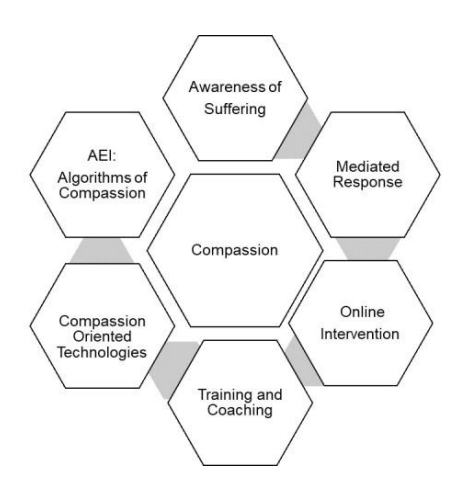
Visual representation of the 7 Domains of Digital Compassion. AEI: artificial emotional intelligence. [Source: Delivery of Compassionate Mental Health Care in a Digital Technology–Driven Age: Scoping Review (Kemp et al., 2020)]
Related Publication
- Caring in a Digital Age: Exploring the Interface of Humans and Machines in the Provision of Compassionate Healthcare (Wiljer, Strudwick & Crawford, 2020) [link]
- Defining Compassion in the Digital Health Age: Protocol for a Scoping Review (Wiljer et al., 2019) [link]
- Delivery of Compassionate Mental Health Care in a Digital Technology-Driven Age: Protocol for a Scoping Review (Strudwick et al., 2019) [link]
- Delivery of Compassionate Mental Health Care in a Digital Technology-Driven Age: Scoping Review (Kemp et al., 2020) [link]
Defining Digital Compassion
Building on this growing body of work, a national eDelphi study brought together patients, healthcare professionals, educators, researchers, healthcare leaders, policymakers, and technology experts from across Canada to develop a shared understanding of digital compassion in practice. The study sought to identify the professional competencies and technology attributes needed to support compassionate care in increasingly digital healthcare environments.
The resulting Digital Compassion Framework identified 58 professional competencies and 15 technology attributes organized across seven domains: digital literacy, patient preferences, collaboration and codesign, therapeutic relationships, ethical implications, patient safety, and technology safety. Together, these domains provide practical guidance for supporting compassionate care in digital healthcare environments and emphasize that technology should support, rather than replace, human relationships through trust, communication, collaboration, and shared decision-making.