Nuclear Medicine & Molecular Imaging Technology: University of Toronto Joint Program
Program at a glance:
Credential Earned: Bachelor of Science in Medical Radiation Sciences from the University of Toronto and Advanced Diploma from The Michener Institute of Education at UHN
Program Length: 3 Years (Full-Time)
Program Delivery: On site with online components (University of Toronto's St. George Campus and Michener’s St. Patrick Campus)
Start Date: September 2025
Application Deadline: February 1, 2025
Program Code: TRN
About the Program
Detect diseases in their earliest stages
The Nuclear Medicine & Molecular Imaging Technology Program (NMMIT) is a joint educational program offered through the University of Toronto and The Michener Institute of Education at UHN. The program is designed using hybrid delivery of course curriculum, which gives students a well-balanced approach to learning by participating in both online and in-person educational experiences with instructors, peers and clinical educators.
Theory is put into practice by examining increasingly complex case studies and applying knowledge in both simulated and clinical environments. NMMIT allows students to experience all aspects of the profession, including:
- Preparing radiopharmaceuticals and handling radioactivity in Michener’s radiopharmacy lab
- Imaging using gamma cameras
- Single-Photon Emission Computed Tomography (SPECT)/ Computed tomography (CT)
- Bone Mineral Densitometry (BMD) scanners
- Providing patient care with simulated patient actors
- Research opportunities
- Exploration of emerging technologies in Positron Emission Computed Tomography (PECT)/ Computed tomography (CT)
- Theranostics
- Interprofessional collaboration
Graduates are eligible to write the national certification examination conducted by the Canadian Association of Medical Radiation Technologists (CAMRT). Certification qualifies graduates to work across Canada and allows them to apply for registration as a nuclear medicine technologist with the College of Medical Radiation and Imaging Technologists of Ontario (CMRITO).
The NMMIT program is accredited by Accreditation Canada . Accreditation is a quality improvement process that ensures educational programs meet national standards and that students acquire the knowledge, skills, and competencies for safe and effective care at entry to practice.
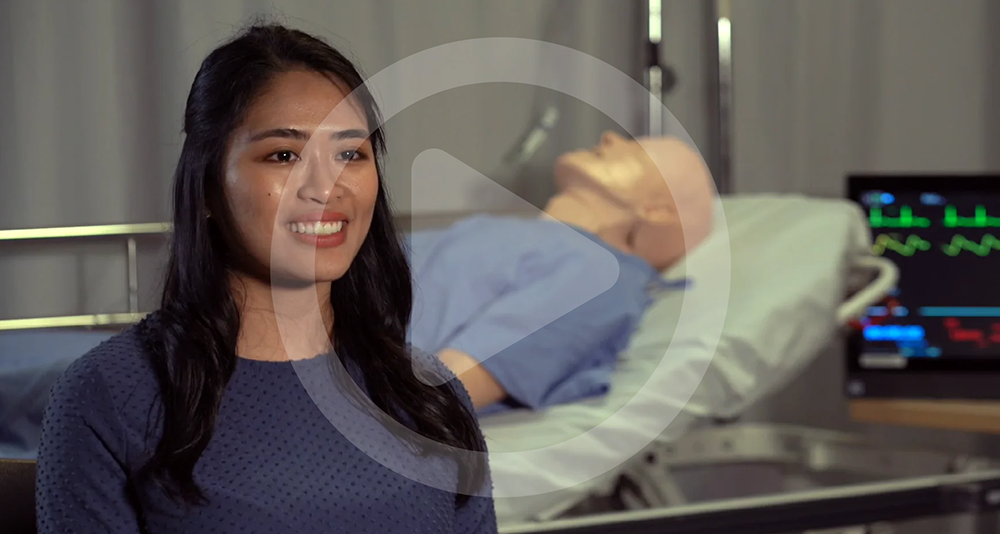
“The program is exceptional because you gain extensive knowledge about nuclear medicine imaging, get hands on experience with gamma cameras and practice your patient care skills.”
Take a Nuclear Medicine & Molecular Imaging Technology Virtual Tour
Visit the U of T website for application information
Admission Requirements
About the Profession
Nuclear Medicine Technologists apply detail oriented technical skills in a compassionate, patient- focused model of care. They use minimally invasive procedures targeted at the diagnosis of specific disease pathologies based on their cellular function in comparison to normal tissues. The highly specific nature of how tracers localize in the body and are imaged, allows for comprehensive diagnostic information using minimally invasive procedures. Determination of tumour or injury location, size, treatment planning and response to treatment can all be accomplished with a small injection of a tracer in a patient’s arm for the majority of procedures with minimal pain or risk of adverse events.
Molecular Imaging uses highly specialized imaging cameras capable of detecting the radiation coming from the tracer inside the patient and form an image which visualizes the biochemical events at the cellular and molecular level, which is unique to any other imaging modality. This is a field of diagnostic imaging that is continually advancing. Its ability to identify regions of pathology and mechanisms of disease, has shown effective for predictions in tumor responsiveness to radiation treatments prior to their administration, which is a growing field known as nuclear theranostics.
Graduates are employed in a variety of clinical environments including community or teaching hospitals, independent health facilities, research institutes, public health institutions, regulatory bodies, commercial radiopharmacies, education, and medical imaging equipment sales or applications.
What Will I Study?
When you enroll in the NMMI program, you will begin by learning both in the classroom and in Michener’s simulated lab setting the instrumentation, radiopharmaceuticals and safe handling of radioactivity that is required to perform nuclear medicine procedures. You will progress through the nuclear medicine integrated core courses to learn the specific diagnostic and therapeutic procedures that are performed on patients. This is done first in the lab and then followed by a combination of both part-time and full-time clinical experiences to help consolidate knowledge and understanding.
The simulated lab environment allows you to practice in a safe learning environment working with a small number of students and directly one-on-one with your instructors. Here you will perform a wide range of specialized techniques for the preparation and administration of radiopharmaceuticals using different routes such as intravenous, oral, inhalation, subcutaneous and intramuscular, how to perform molecular imaging using the nuclear medicine dedicated gamma cameras and how to explain imaging procedures to the patient and answering questions. This will ensure that you are ready when at your clinical placement.
For detailed course descriptions please see the UofT Nuclear Medicine & Molecular Imaging Program page.
Clinical Education
Length: 48 weeks
- 6 week-long rotations in Year 2
- 12 weeks at the end of Year 2
- 30 weeks in Year 3
In the second year of the program, you will complete a part-time clinical placement at a Greater Toronto/Hamilton Area (GTHA) affiliated clinical site for 3 weeks during both Fall and Winter semesters to integrate your didactic learning with hands-on clinical experience. In your final year of the program, you will complete your full-time clinical placement at any one of our affiliated clinical sites in Ontario for three full semesters starting with the second-year summer semester, followed by the Fall and Winter semesters in your third year of study. During this final clinical experience, you will be placed at the same base site for three full semesters.
As clinical education is a major component of all Michener programs, our affiliated clinical sites are integral to your education, and they include teaching and community hospitals as well as Independent Health Facilities (IHF’s). Working closely under the supervision of Nuclear Medicine Technologists, you will have the opportunity to integrate knowledge and skills into practice during the clinical phase of your program. Clinical placements give you hands-on experience in work environments and the opportunity to network with potential employers.
For more information about Clinical Education, please see Michener’s Clinical Education Model page.
Additional Resources
- Canadian Association of Medical Radiation Technologists (CAMRT)
- College of Medical Radiation and Imaging Technologists of Ontario (CMRITO)
- Ontario Association of Medical Radiation Scientists (OAMRS)
- Nuclear Medicine Technology Certification Board (NMTCB)
- Society of Nuclear Medicine and Molecular Imaging (SNMMI)
Textbooks
Scholarship&Bursaries
Tuition